OEM / ODM vacuum sealer manufacturer
Vacuum sealers built for your market, brand and price point.
From household models to commercial machines, we help you choose the right platform, customize it for your market and move from sample to mass production with a clear plan.
Household → commercial
External, professional, chamber and cordless platforms.
Dry, moist & liquid-rich food
Choose the machine architecture around the real food and workload.
OEM / ODM market versions
Branding, controls, voltage, plug and packaging for your channel.
Sample → mass production
Product selection, testing, quality control and repeat-order support.
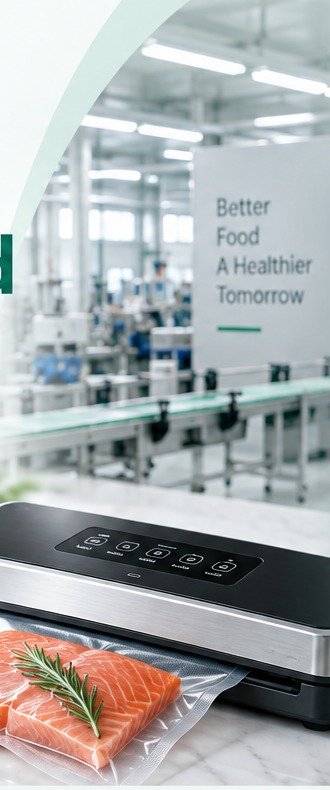
Vacuum sealing platforms for retail and commercial programs
Household · Professional · Commercial · Chamber · Cordless
Product coverage
Vacuum sealer range
40 vacuum sealer models covering household, professional and commercial use.
Accessory ecosystem
Bags, rolls & accessories
5 product families spanning bags, rolls, canisters and related accessory options.
Output capacity
Normal monthly machine capacity
Overall normal monthly machine capacity across standard vacuum sealer programs.
Manufacturing setup
Assembly + injection support
2 assembly lines and 2 injection lines to support production consistency and supply continuity.
Pre-shipment validation
Core function check before packing
Every machine receives a core-function check before packing and shipment.
Quality coverage
Incoming material to final shipment
Quality checks run from incoming materials through in-process control to final shipment.
Tell us how you sell. We will show you what matters most.
Choose the route that matches your business and project stage.
First launch / new category
Start with a proven model, manageable customization, sample guidance and a clear launch timeline.
Amazon / DTC
Focus on user experience, return risk, packaging size, margin and dependable reorders.
Importer / Distributor
Build a product range with clear price tiers, market-ready versions and stable repeat supply.
Retail / Private Label
Get shelf-ready packaging, consistent quality, delivery planning and support for retailer requirements.
Foodservice / Processor
Choose by food type, daily volume, sealing speed, cleaning and uptime.
Established brand / Second source
Compare performance, factory capability, supply continuity and the documents your team needs for approval.
Dealer / Service channel
Choose products that are easier to service, with spare parts, troubleshooting and warranty support available.
Buying agent / Sourcing office
Get clear product, factory and quotation information that is easy to share with your client.
Already know what matters most? Start there.
Choose your top priority and we will highlight the product features and questions worth focusing on before you request a quote.
Easy first launch
Quieter operation
Moist food
Better margin
Premium experience
Faster commercial use
Choose by use case, then compare the right product family.
Household, professional, commercial, chamber and cordless platforms are available for different workloads.
10 models
Mini / Entry
Compact, value-focused machines for simple everyday vacuum sealing and price-sensitive programs.
Best for: first launches, entry price points and compact retail packs.
Ask about this range13 models
Multifunction Household
Flexible everyday platforms with Dry/Moist options, accessory connections and broader branding choices.
Best for: mainstream retail, Amazon / DTC and multi-market household programs.
Ask about this range2 models
Hands-free
No manual lid-locking step, making everyday operation simpler without implying fully unattended operation.
Best for: brands that want easier operation and a differentiated premium feature.
Ask about this range7 models
Professional
Higher-feature household and prosumer models with roll storage, cutters and stronger everyday convenience.
Best for: higher retail tiers, frequent home users and feature-led programs.
Ask about this range3 models
Commercial External
Designed for heavier workloads where sealing speed, repeat cycles, durability and service access matter more.
Best for: butcher shops, seafood, foodservice and heavier daily external sealing.
Ask about this range3 models
Chamber Vacuum
A stronger fit for liquid-rich foods and commercial processing where repeatable sealing and workload are critical.
Best for: sauces, marinades, processors and higher-volume commercial operations.
Ask about this range2 models
Cordless / Rechargeable
Portable options for customers who value flexible placement, easy storage and cordless operation.
Best for: compact kitchens, portable use and channels looking for a different format.
Ask about this range5 families
Accessories & Consumables
Bags, rolls, canisters and related accessories that extend the range and create repeat-purchase opportunities.
Best for: bundles, repeat sales and programs that need a complete sealing ecosystem.
Ask about this rangeExternal sealer or chamber machine? Start here before comparing features.
Food type, free liquid, bag format and daily workload should decide the machine architecture first.
External sealer
Best when flexibility, retail price and countertop use matter.
Chamber machine
Best when liquids, repeatability and batch work become the priority.
Build the product line around the machine.
Bags, rolls and compatible accessories make the range easier to use, bundle and reorder.
Vacuum bags & rolls
Canisters & hose
Starter kits & bundles
Service parts
See what sits behind your order.
From product development to production, testing and packing, these are the parts of the factory setup buyers usually want to understand.
China engineering + Cambodia production
Product development
Production & assembly
Performance checks
Ready for delivery
From approved sample to packed order.
Keep what you approved consistent through material checks, production, testing and packing.
Materials arrive
Parts are prepared
First units are checked
Assembly begins
Core functions are tested
Pack & label
Final release
Built for the markets you sell in.
Match voltage, plug, labeling, packaging and available certification documents to the selected model.
United States
European Union
United Kingdom
Japan
Australia / New Zealand
Other / Multi-market
Where do vacuum sealer orders usually go wrong?
Most product problems are predictable: weak vacuum, poor seals, difficult moist-food use, overheating, noise or a production result that does not match the sample.
Weak vacuum / air leaks
Seal failure / uneven seals
Moist-food performance
Heat & repeat cycles
Bag & roll compatibility
Sample versus mass production
Your production order should match the sample you approved.
We check the product at key points from incoming materials to final shipment, with the approved sample and agreed product details as the reference.
Approved sample baseline
Incoming material checks
Core function testing
Final inspection
How much do you actually want to change?
Custom can mean a logo and market version, or a new vacuum system, control board or product structure.
Branding & packout
Market configuration
Appearance & UX
Performance & electronics
Full product ODM
Test the right things before you commit to volume.
A useful sample should answer the questions that matter to your launch: product feel, real-food performance, market version, branding and packaging.
Start with the right model
Test it in real use
Confirm your version
Approve before production
The first shipment is not the end of the project.
For a growing brand or distributor, the next questions are whether the product can be reordered, traced and supported.
Repeat-order consistency
Batch traceability
Spare & service items
Problem follow-up
Different buyers need different approval paths.
These representative sourcing scenarios show how the recommended route changes with buyer maturity, portfolio needs and manufacturing risk.
Keep the first launch focused.
Build a range, not just another SKU.
Move production without losing the approved baseline.
A useful quote must lock more than model, quantity and logo.
The commercial offer should be tied to a defined product version and approval baseline.
Product details
Order details
Market and compliance
Packaging and launch timing
Frequently asked questions
Are you a factory or a trading company?
EverFresh works with a two-location setup: product development and engineering in Dongguan, China, with mass production, testing and packing in Takeo, Cambodia. Some specialized components are sourced from qualified suppliers and integrated into the finished product.
How do you keep production consistent with the approved sample?
We work from the approved product specification and sample, check incoming materials and key production stages, test core functions before packing and carry out final inspection before shipment.
Why can two machines with the same vacuum claim perform differently?
Vacuum level is only one part of the experience. Vacuum speed, air flow, sealing quality, leakage, noise, temperature and control logic can all change how the machine performs in real use.
Is a dual-pump model always better?
Not necessarily. A dual-pump design can improve speed or performance on some products, but it may also add cost, noise and size. The right choice depends on the customer, workload and target price.
Can one product be sold in several countries?
Often yes, but different markets may need different voltage, plugs, labels, manuals, packaging or certification documents. We can help plan those versions around one base product where possible.
If two models look similar, can they use the same certificate or test report?
Not automatically. Coverage depends on the document scope and the actual construction, voltage, PCB / BOM and safety-critical parts. We confirm the selected production version against the applicable document before treating it as covered.
Can you support a second-source project?
Yes. We can compare your current product requirements with our available platforms, prepare samples for side-by-side testing and work through a controlled transition if the fit is right.
What should a food processor tell you before choosing a machine?
Food type, bag size, daily volume, peak workload, desired sealing speed, liquid content, cleaning needs and service expectations. These details help us choose between external and chamber machines.
What information do you need for a quote?
Target market, expected quantity, preferred product type, must-have functions, branding or packaging needs and your target launch date. A target price is also helpful if you have one.
Share your project details
The RFQ form will be added as a native Bricks Form after the email or CRM destination is confirmed.